
Erika NJ Allen
Art is my way of nurturing connections—with my own story, with others, and with the shared narratives that shape our world. Born in Guatemala and a first-generation college graduate, I use my work to bridge themes of consumption, labor, migration, and resilience. Through ceramics and photography, I explore the intersection of personal and political experiences, challenging cultural assumptions and fostering empathy.
In May 2019, during my final year of earning a BFA, I underwent a hysterectomy, a life-changing experience that transformed my relationship with my body, food, and art. During recovery, fruits and vegetables became more than sustenance; they became meditative symbols of resilience and healing. This connection inspired me to replicate the produce I consumed in clay, imprinting real fruits onto ceramic surfaces. These works blur the line between authenticity and artifice, reflecting my body’s own duality—where the natural and medical coexist, one decaying while the other endures.
Two years later, while pursuing my MFA at Cranbrook Academy of Art, I fractured my wrist. This physical limitation forced me to adapt, sparking unexpected discoveries. One ordinary banana led to the development of a unique glazing technique that reshaped my porcelain and stoneware creations. What began as a personal exploration grew into a political dialogue, with my banana-inspired works symbolizing the resilience of marginalized communities and drawing attention to the global histories of labor and exploitation within the banana industry.
As I delve deeper into the cultural and economic impact of the banana industry, I explore how it has shaped migration and immigration experiences, uprooting communities and intertwining their survival with systems of labor and exploitation. Through this exploration, I aim to nurture empathy, inviting viewers to consider the human cost of these systems and to reflect on the resilience required to endure and adapt.
My practice has evolved beyond personal storytelling to engage larger systems of labor and consumption, exploring how they shape identity and collective experiences.
I am honored to have received recognition such as the 2024 NCECA Emerging Artist Award and the 21c Cincinnati Artadia Award, alongside participating in residencies including the Archie Bray Foundation for the Ceramic Arts.
Through my art, I aim to create spaces for reflection and connection. I invite others to share their own stories, transforming hardship into a shared celebration of resilience. My journey as an artist—and as a survivor—speaks to the enduring strength of the human spirit. Whether confronting systemic barriers or celebrating cultural heritage, my work invites dialogue, inspiring audiences to find beauty in resilience and the power of transformation.

Decorate With Fruit 2024
Ceramics, archival photography

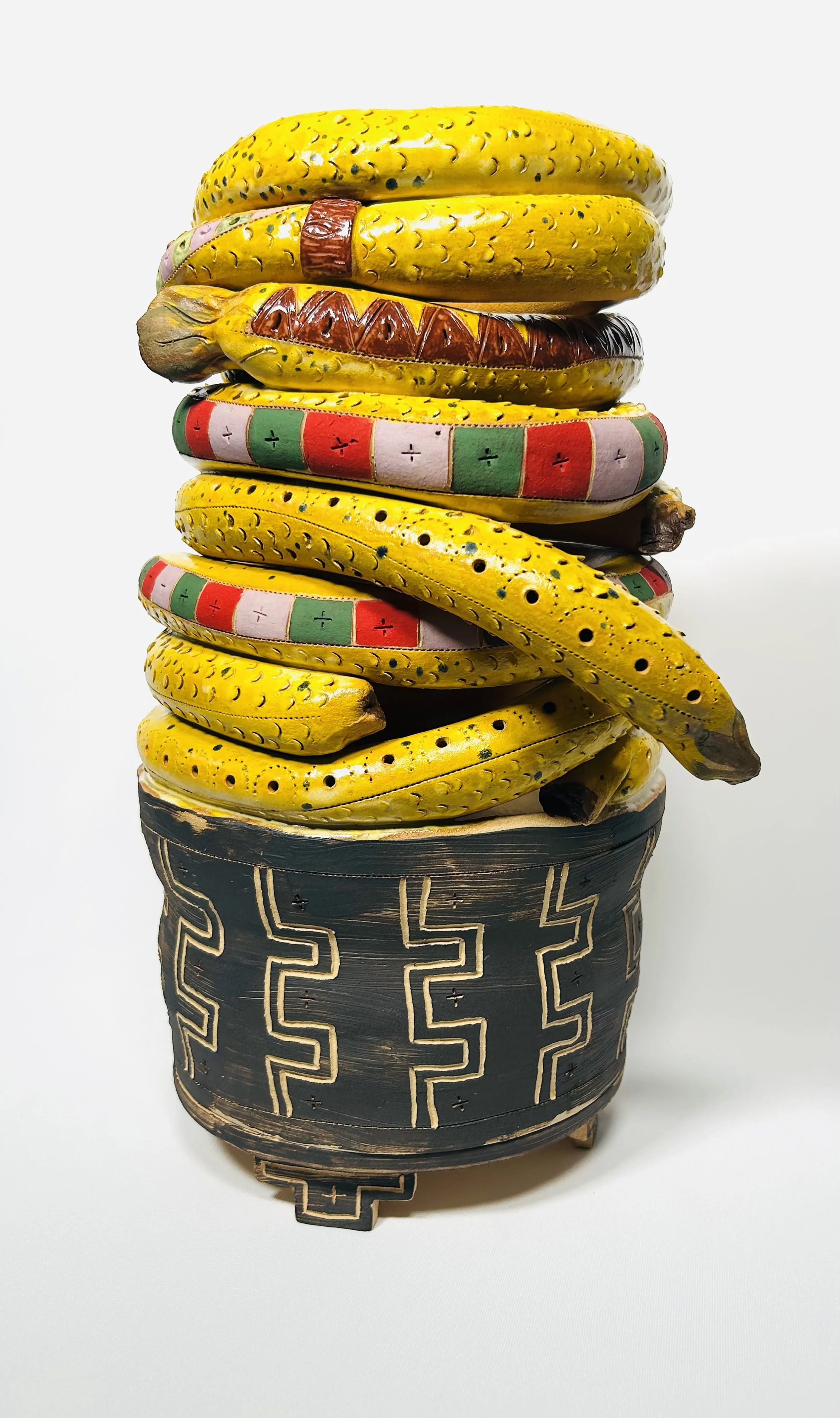
Monument to Banana Workers MCMLIV
This piece carries two histories at once. The base, hand-built in the tradition of my Mayan ancestors — black stoneware slip over beige clay — is carved with glyphs of bananas crawling upward like snakes, already whispering what the tower above will say out loud.
The year the United Fruit Company, backed by the CIA, helped overthrow Guatemala's democratically elected president Jacobo Árbenz — because he wanted to give land back to the people working it. One moment in a long chain of events that displaced communities, disrupted economies, and set migration in motion.
The bananas are coiled and machine-extruded — a deliberate nod to industrial production. Some wear bands of color drawn from Mayan textile patterns, wrapping the worker, the weaver, and the ancestor into the fruit itself. And they carry another presence: the barba amarilla, the fer-de-lance snake that still lives in the plantations today, camouflaging among the leaves, just like history hiding its venomous true identity.
Hand-built base. Machine-made tower. Ancestral craft holding industrial weight. That tension is intentional.
This isn't about vilifying an industry. It's about following a thread — from a boardroom decision in 1954 to a border crossing today — and asking for empathy toward the people caught in between.
Clay holds memory. So do bodies. So do borders.
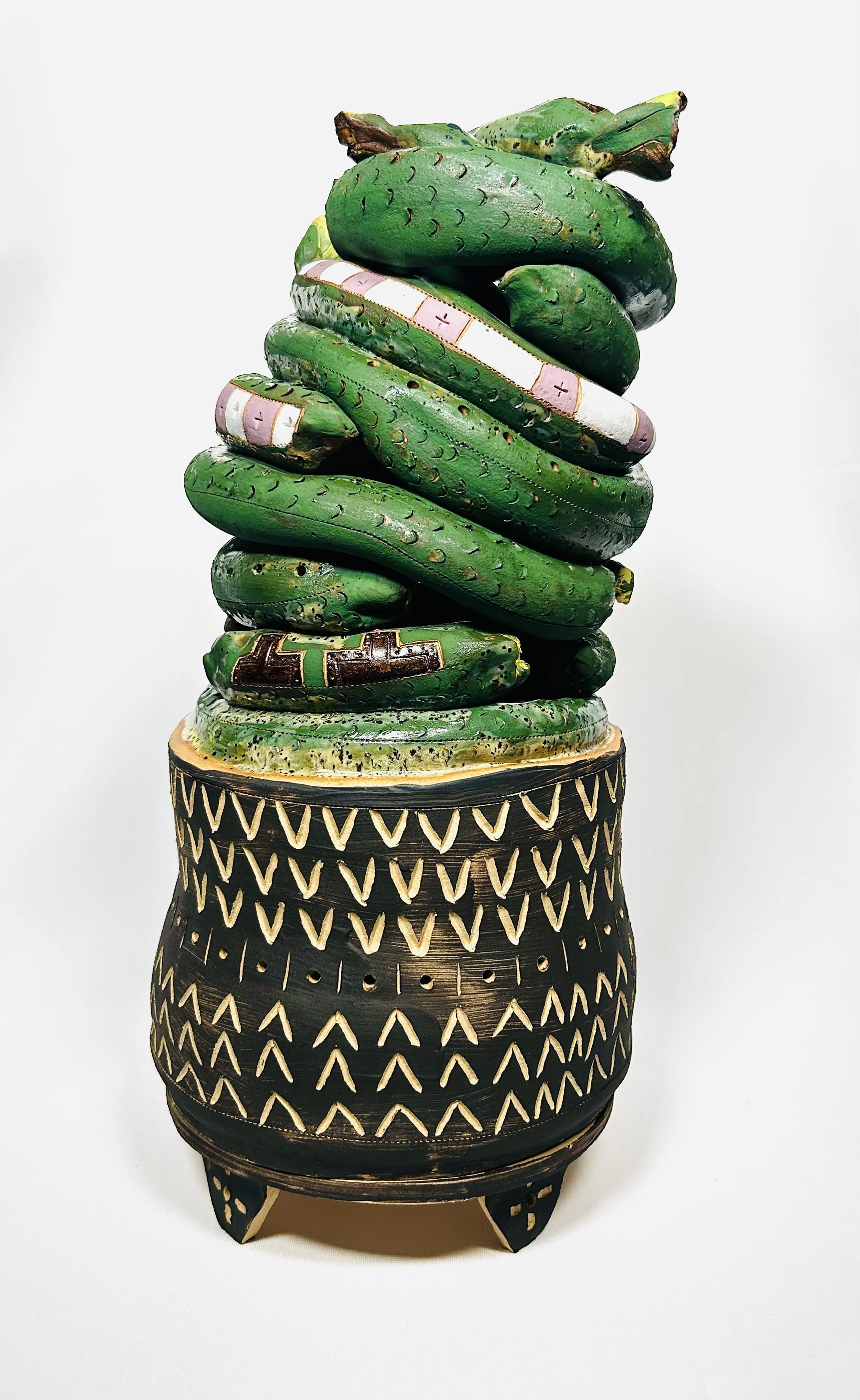
Monument to Banana Workers MDCCCXCIX
The year the United Fruit Company was founded — and with it, the beginning of a long chain of consequences that still echo today.
The base, hand-built in the tradition of my Mayan ancestors — black stoneware slip over beige clay — is carved with arrows pointing up and down, cycles of movement with no clean resolution. Above it, a tower of green bananas, coiled and machine-extruded, waiting to ripen. Some wear bands of color drawn from Mayan textile patterns, wrapping the worker, the weaver, and the ancestor into the fruit itself.
Green. Unripe. The wound at its origin.
This isn't about vilifying an industry. It's about following a thread — from a founding decision in 1899 to a border crossing today — and asking for empathy toward the people caught in between.
Clay holds memory. So do bodies. So do borders.